Abram was seventy-five when God promised to make him a great nation (Genesis 12:4). Isaac, the son that promise depended on, was born when Abraham was a hundred (Genesis 21:5). He waited twenty-five years.
“Now the LORD had said to Abram: ‘Get out of your country, from your family and from your father’s house, to a land that I will show you. I will make you a great nation…’ So Abram departed as the LORD had spoken to him.” (Genesis 12:1-2, 4, NKJV)
Those were not twenty-five days of testing or one long night of prayer. They were a quarter of a century inside a promise that had been clearly spoken and did not seem to move.
What the Waiting Looked Like
Scripture is honest about those years. Abraham and Sarah tried to bring about the promise themselves through Hagar, and the birth of Ishmael brought conflict into the family (Genesis 16:1-4). Twice Abraham said Sarah was his sister because he feared for his life, and twice he nearly lost her to a foreign king (Genesis 12:11-13; 20:2). When the promise was repeated in Sarah’s hearing, she laughed, because she was long past the age of bearing children (Genesis 18:11-12). They were frightened and doubting people, still holding on to a promise they could neither fully believe nor let go.
Yet Paul, looking back, describes something happening beneath all that:
“And not being weak in faith, he did not consider his own body, already dead (since he was about a hundred years old), and the deadness of Sarah’s womb. He did not waver at the promise of God through unbelief, but was strengthened in faith, giving glory to God.” (Romans 4:19-20, NKJV)
Read alongside Genesis, with its lies, its scheme involving Hagar and Sarah’s laughter, Paul is clearly not describing a man who never doubted. He is describing what God was building in Abraham underneath the doubt.
She Judged Him Faithful
Hebrews includes Sarah among the faithful, laughter and all:
“By faith Sarah herself also received strength to conceive seed, and she bore a child when she was past the age, because she judged Him faithful who had promised.” (Hebrews 11:11, NKJV)
Her first recorded response to the promise was a laugh that she then denied out of fear (Genesis 18:15). Somewhere in those uncertain years she came to a settled conclusion: God was faithful. Her faith did not mean the struggle was absent. It was the conviction that outlasted the struggle.
Inside the Chrysalis
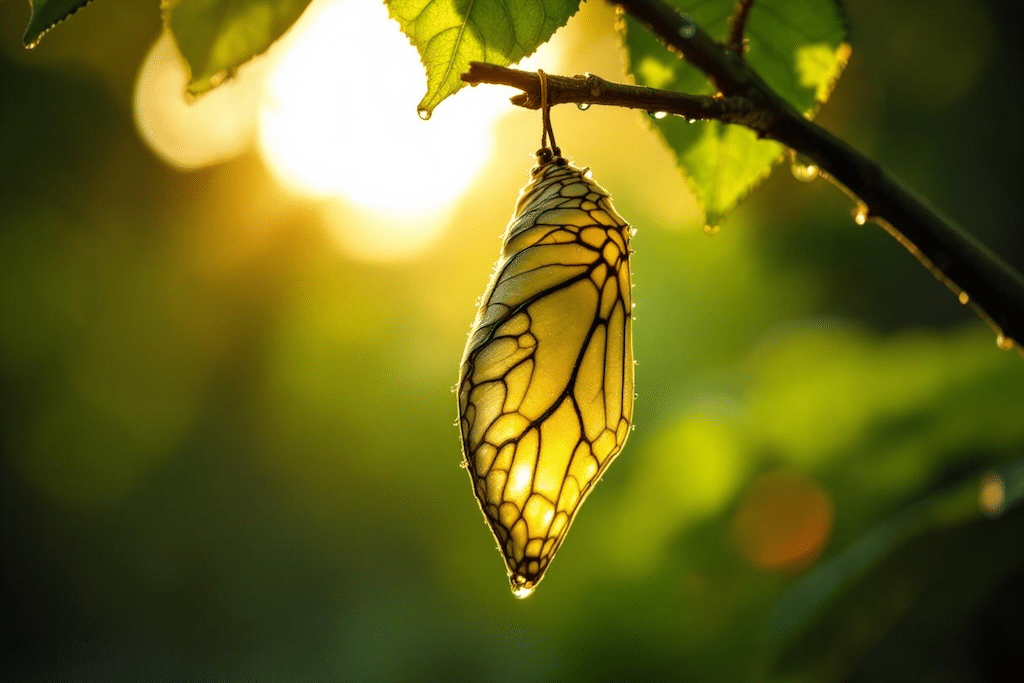
From the outside, a butterfly chrysalis hanging from a branch looks completely still. Inside, the caterpillar’s body is breaking down and being rebuilt into something it could never have become by effort. Cut the chrysalis open too early and you find a half-formed creature with crumpled wings that will never fly. The waiting is not empty time before the real work begins. It is where the work happens, even though nobody can see it or hurry it.
Eleven Years of Waiting
Picture a couple who spend eleven years trying to have a child. Their prayers are real, and so are their doubts. Several rounds of treatment fail, and for a while they stop attending baby dedications at church because the ache is too much. Nobody would describe those years as a triumphant walk of faith; most days it looks like tired endurance. Their daughter is born when the wife is forty-three. The husband cannot point to the moment his faith became settled. He only knows that somewhere in the long middle stretch he stopped demanding an explanation and kept turning up, day after day.
An African proverb says that patience can cook a stone. It is slow and uncomfortable to watch, but time, endured with trust, accomplishes what force cannot.
Not Every Wait Ends on Our Timetable
This is not a guarantee that every wait will end as Abraham’s did. Many of the faithful in Hebrews 11 died “not having received the promises, but having seen them afar off” (Hebrews 11:13, NKJV), and their hope rests on the resurrection. The point is that waiting is not a pause in the story. Very often it is the story, and God is at work in it.
If you are in a long season of waiting, ask yourself whether you have been trying, like Abraham and Hagar, to force an outcome God seems slow to bring. Then think of one thing that has changed in you during this season, and thank God for the work He is doing that you cannot yet see.
If waiting on God is something you are struggling with now, I have written more about trusting His timing in my book Yet Will I Trust Him, which you can read online or download free.