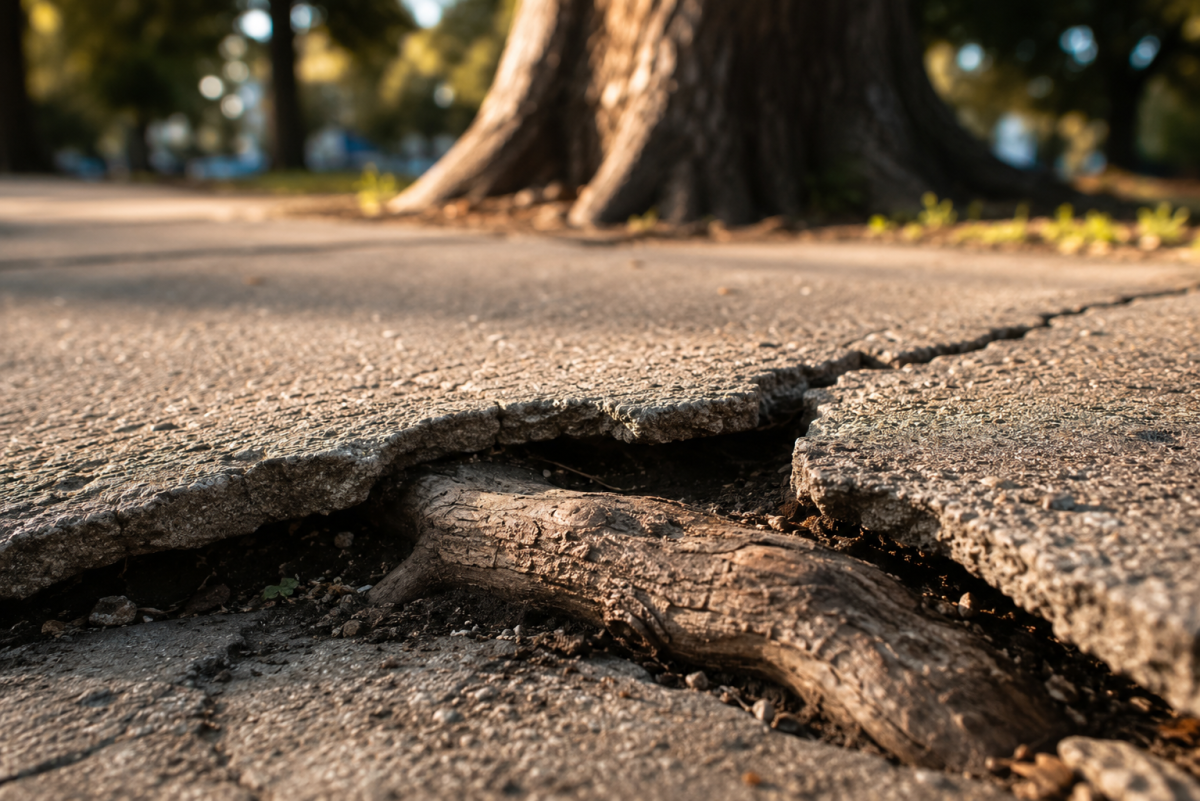
A sidewalk rarely cracks where the actual root is. Tree roots, searching underground for water, can travel twenty feet or more from the trunk before finally pushing hard enough against a slab of concrete to split it open — which means the crack a pedestrian trips over, the one they blame on “bad concrete” or “poor city maintenance,” is very often nowhere near what actually caused it.
The real root doing the real damage stays hidden below the surface, working quietly out of sight, while everyone stares at the break where it finally showed up.
Relationships tend to crack in almost the same pattern. The visible break — the argument, the silence, the accusation — rarely appears exactly where the real problem started. And the first instinct, when something finally splits open between two people, is to examine the crack itself and name whatever’s standing nearest to it, rather than tracing the damage back to whatever actually caused it.
Adam was the first person in Scripture to point at the crack instead of the root.
The Answer That Blamed Everyone but Himself
When God asked Adam a direct question about what he had done, the answer he gave managed to accuse two people before admitting anything at all.
“Then the man said, ‘The woman whom You gave to be with me, she gave me of the tree, and I ate.’” — Genesis 3:12, NKJV
The woman whom You gave to be with me. Look at the shape of that sentence before its content. Adam blames God first, for giving him Eve. He blames Eve second, for giving him the fruit. His own verb — “I ate” — arrives last, almost as an afterthought, buried under two layers of blame. This is the first recorded instance of a person under pressure reaching for someone else’s fault before reaching for their own, and it would not be the last time Scripture records the pattern.
The King Who Blamed His Own Army
Saul disobeyed a direct instruction from God, and when Samuel confronted him, his defense pointed everywhere except at himself.
“And Saul said, ‘But I have obeyed the voice of the LORD… The people took of the plunder, sheep and oxen, the best of the things which should have been utterly destroyed, to sacrifice to the LORD your God in Gilgal.’” — 1 Samuel 15:20-21, NKJV
The people took of the plunder. Saul was the king. The command had been given to him. And his answer, remarkably, insists he obeyed while describing, in the very next breath, exactly how he didn’t — quietly shifting the blame onto the army he was supposed to be leading. Samuel’s response left no room for the excuse: obedience, not sacrifice, was what had actually been asked of him.
The Excuse That Blamed the Fire Itself
Aaron built a golden calf for Israel to worship while Moses was still on the mountain. His explanation to Moses afterward is almost hard to believe.
“So I said to them, ‘Whoever has any gold, let them break it off.’ So they gave it to me, and I cast it into the fire, and this calf came out.” — Exodus 32:24, NKJV
This calf came out. As though the fire had shaped the idol on its own, with no hands involved. Aaron’s excuse doesn’t even blame another person — he blames the process itself, describing his own deliberate craftsmanship as something that simply happened to him. It is, perhaps, the most transparent excuse in Scripture, and it’s recorded exactly because of how familiar that instinct still feels.
A Story Worth Sitting With
I know a couple who nearly ended their marriage over a financial decision made without full honesty on either side. When it finally came out, the conversation that followed wasn’t really a conversation — it was two people taking turns explaining. He explained the pressure he’d been under at work. She explained why she hadn’t asked more questions when she noticed the numbers didn’t add up. Both explanations were, in a narrow sense, true. Neither one actually said “I was wrong.” Months later, in counseling, the breakthrough came not from a better explanation but from the absence of one — when he finally said, without qualification, “I hid this from you, and that was wrong,” and she said, without qualification, “I noticed and said nothing, and that was wrong.” The marriage didn’t heal when the explanations got clearer. It healed when the explanations stopped.
The excuse and the apology can sound remarkably alike from the outside, but only one of them ever actually settles anything.
What This Isn’t Saying
This isn’t an argument against explaining yourself, or a suggestion that context never matters. There is a real and healthy place for helping someone understand what led to a decision, once the ownership itself has already been given plainly. The danger was never explanation itself. It was explanation offered as a substitute for confession, or ahead of it — the way Adam’s excuse arrived before his admission, not after it. Scripture’s own instruction points toward what actually resolves guilt, and it isn’t a better account of the circumstances: “If we confess our sins, He is faithful and just to forgive us our sins and to cleanse us from all unrighteousness” (1 John 1:9, NKJV). Confession, not context, is what that verse says God is actually responding to.
Five Questions Worth Sitting With
- When something goes wrong in my closest relationships, is my first instinct to explain my own part, or to explain someone else’s?
- Like Saul, have I ever technically admitted a fault while quietly redirecting the blame in the same breath?
- Is there an excuse I’ve been offering so long it has started to feel like the truth, the way Aaron’s fire story might have to him?
- What would it cost me to say “I was wrong,” full stop, the next time I’m tempted to add “but”?
- Is there a relationship in my life still waiting for an apology that hasn’t arrived because I’ve been busy preparing an explanation instead?
Final Word
A cracked sidewalk can be patched a hundred times and split open again in the same place, for as long as the root underneath it is never actually dealt with. Confession is what finally reaches the root. Explanation only ever patches the crack. Adam had the choice to do either, standing in the garden with the question still hanging in the air. So do we, standing wherever ours is.