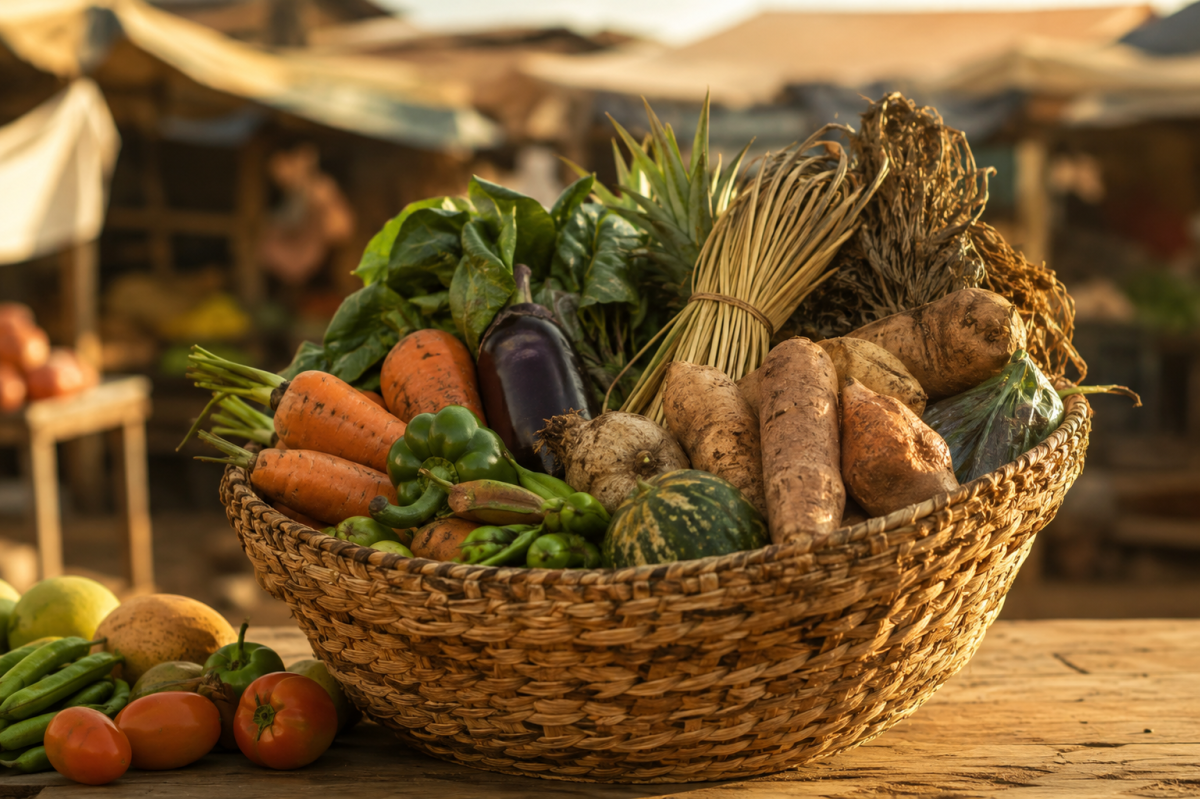
Every market woman’s basket, examined at the end of a trading day, tells an honest story before she says a single word about it. What she filled it with reveals exactly what she went out looking for — and just as tellingly, what she walked straight past without a second glance, however good a bargain it might have been. Two women can walk through the exact same market, past the exact same stalls, and come home with entirely different baskets, because each basket was shaped less by what was available than by what each woman had already decided mattered.
A prayer list works the same way. It’s rarely a random collection. It’s a fairly accurate map of what we’ve quietly decided is worth bringing to God — and, just as tellingly, what we’ve never thought to ask Him for at all.
Solomon’s List, and What It Revealed
When God appeared to the young King Solomon and offered him, remarkably, an open request — “Ask! What shall I give you?” (1 Kings 3:5, NKJV) — what Solomon chose to ask for exposed his heart more precisely than any sermon could have:
“Give to Your servant an understanding heart to judge Your people, that I may discern between good and evil. For who is able to judge this great people of Yours?” — 1 Kings 3:9, NKJV
Notice what he didn’t ask for. Not long life, not wealth, not victory over his enemies — all of which God specifically names as things Solomon could have requested (1 Kings 3:11). Solomon’s list revealed a man more concerned with serving well than with being comfortable. God’s own response confirms the diagnostic power of the request itself:
“So God said to him: ‘Because you have asked this thing, and have not asked long life for yourself, nor have you asked riches for yourself, nor have you asked the life of your enemies, but have asked for yourself understanding to discern justice, behold, I have done according to your words.’” — 1 Kings 3:11-12, NKJV
God didn’t just answer the request. He read the list and told Solomon exactly what it revealed about him.
James’s Uncomfortable Diagnosis
Not every prayer list receives that kind of commendation. James is remarkably direct about lists that reveal something less noble:
“You lust and do not have. You murder and covet and cannot obtain. You fight and war. Yet you do not have because you do not ask. You ask and do not receive, because you ask amiss, that you may spend it on your pleasures.” — James 4:2-3, NKJV
Ask amiss. A prayer list entirely populated by personal comfort, personal advancement, and personal relief — with nothing on it for anyone else’s need, no room for God’s own purposes beyond what benefits the one holding the pen — is itself a diagnosis, whether or not the individual requests seem reasonable in isolation. A basket full of nothing but sweets isn’t inherently sinful item by item. It does, however, say something honest about what the shopper actually went looking for.
Paul’s Lists for Other People
It’s worth noticing what fills Paul’s own prayer lists in his letters, because they’re almost entirely about people other than himself:
“That the God of our Lord Jesus Christ, the Father of glory, may give to you the spirit of wisdom and revelation in the knowledge of Him, the eyes of your understanding being enlightened; that you may know what is the hope of His calling, what are the riches of the glory of His inheritance in the saints.” — Ephesians 1:17-18, NKJV
“That you may be filled with the knowledge of His will in all wisdom and spiritual understanding; that you may walk worthy of the Lord, fully pleasing Him, being fruitful in every good work and increasing in the knowledge of God.” — Colossians 1:9-10, NKJV
Read across several of Paul’s letters, and a pattern emerges: his prayer lists are consistently about other believers’ spiritual depth, not their circumstances — wisdom, revelation, fruitfulness, endurance, love abounding in knowledge and discernment (Philippians 1:9). Rarely does Paul’s recorded prayer list ask for easier circumstances on someone else’s behalf. It asks, again and again, for stronger souls able to meet whatever circumstances come.
A Story Worth Sitting With
I know a woman who kept the same prayer journal for over twenty years, and once let me look through a few old pages spanning different decades of her life. In her teens, the list was almost entirely about herself — a job, a husband, a house, relief from specific worries. By her thirties, the list had shifted noticeably: her children’s character rather than their comfort, her marriage’s continued depth and strengthening rather than its ease, her own patience rather than her own circumstances changing. By her forties, entire pages were given over to names of her spiritual family members, the body of Christ, names that weren’t her family at all — ministers she’d never met, a stranger’s prodigal son, a nation in crisis on the news that week. She hadn’t set out to chart her own spiritual growth. But looking back across those decades, the list did it for her, more honestly than she could have described it herself.
There’s a proverb worth sitting with here: show me your basket, and I will tell you what kind of hunger you carry.
Five Questions Worth Sitting With
- If someone read my prayer list without knowing me, what would they conclude I valued most?
- How much of my list is about my own comfort, and how much is about others’ genuine good?
- Like Solomon, would I know what to ask for if God offered me one open request today?
- Does my list ask God only to change my circumstances, or also to change me within them?
- Whose name is missing from my list that Paul, reading it, would have expected to find there?
Final Word
The market woman’s basket never lies about what she went looking for, however she might explain her choices afterward. Neither, in the end, does a prayer list. It’s not a performance for God, who already knows the heart behind every request before it’s spoken (Matthew 6:8) — it’s a mirror for us, showing us plainly what we’ve decided is worth bringing to Him, and just as plainly, what we’ve never thought to ask for at all.
Worth checking, every so often, what’s actually in the basket — and worth asking, as Solomon once did, whether there’s something better still worth requesting, for the sake of a Kingdom being built for more than just ourselves.