Villages near active volcanoes have always lived inside a strange contradiction. When the mountain finally erupts — fields buried, homes lost, sometimes lives taken — the grief in that moment is real and immediate, regardless of anyone’s knowledge of what comes after. And yet those same villagers, generations deep in that land, know something the ash cloud doesn’t announce: the very destruction burying their crops today is what will make the soil extraordinarily fertile for decades to come.
Volcanic ash breaks down into some of the richest farmland on earth. Knowing this doesn’t erase the grief of the eruption itself. People still weep over what the mountain just took, even while understanding, with real certainty, that restoration is already written into the very ash falling around them.
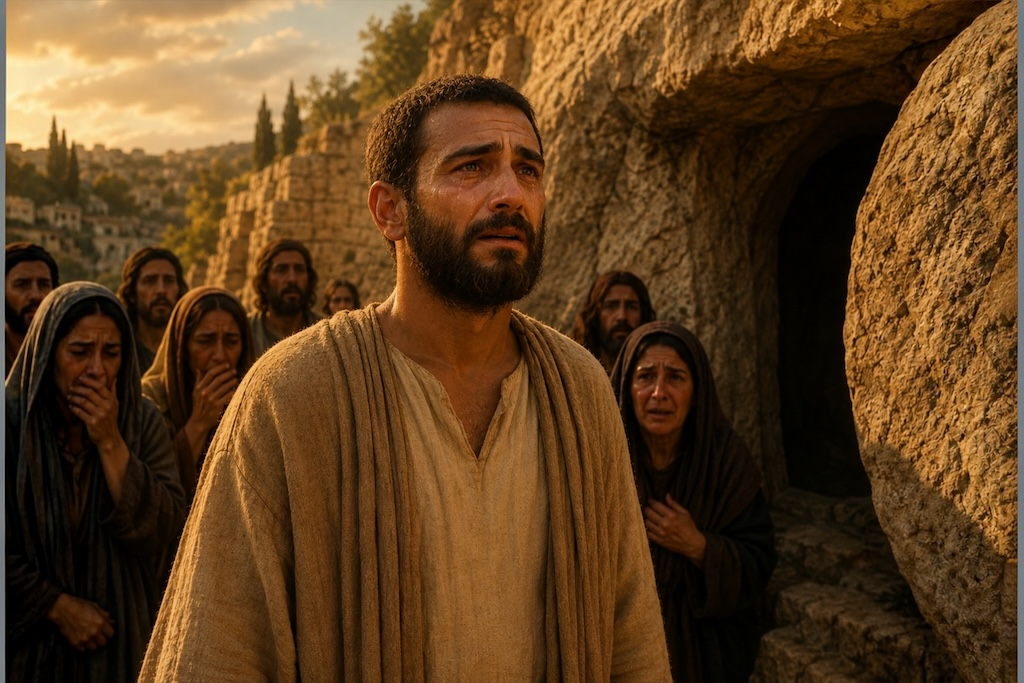
Christ stood at Lazarus’s tomb in exactly that kind of tension — full certainty of the resurrection He was about to perform, and full, unhidden grief at the death that had made it necessary.
The Shortest Verse, and the Strangest One
John records the moment with a sentence so brief it’s easy to read past its weight:
“Jesus wept.” — John 11:35, NKJV
Two words in English, and they arrive after John has already told us, in no uncertain terms, that Christ knew exactly how this story would end. Days earlier, receiving word that Lazarus was sick, He’d said plainly:
“This sickness is not unto death, but for the glory of God, that the Son of God may be glorified through it.” — John 11:4, NKJV
And moments before He wept, He’d told Martha directly:
“Jesus said to her, ‘Your brother will rise again.’” — John 11:23, NKJV
This was not a man uncertain of the outcome, caught off guard by loss, grasping for hope in the dark the way the rest of us often are at a graveside. Christ knew, with complete confidence, that within minutes He would call Lazarus back out of that tomb. And He wept anyway.
Not Ignorance. Something Else Entirely
The Greek word John uses for Christ’s reaction just before the tomb is worth sitting with — He was “greatly troubled” and “deeply moved” (John 11:33, NKJV), language that in the original carries a sense of visceral, almost physical disturbance, not gentle sentimentality. Whatever was happening in Christ at that graveside wasn’t confusion about what death meant, or doubt about His own power over it. It was something closer to righteous grief — sorrow at the very existence of death itself, at what it had done to a family He loved, even while standing one sentence away from undoing it completely.
This matters more than it might first seem, because it tells us something about grief that our own instincts often get backwards: certainty about the outcome does not cancel the legitimacy of present sorrow. Christ, who knew Lazarus would be walking out of that tomb within the hour, still let Himself feel the full weight of Mary and Martha’s loss, still stood in the actual grief of the moment rather than skipping ahead to the resolution He alone knew was coming.
The Resurrection and the Life, Standing at a Grave
Just before this, Christ had made one of His clearest statements about what death actually is and isn’t:
“Jesus said to her, ‘I am the resurrection and the life. He who believes in Me, though he may die, he shall live. And whoever lives and believes in Me shall never die.’” — John 11:25-26, NKJV
This is the same hope Scripture holds out for every believer who has since gone the way Lazarus did — not a permanent, final ending, but a sleep awaiting resurrection at Christ’s own return, when the dead in Christ rise first at the sound of the last trumpet (1 Thessalonians 4:16). Lazarus’s raising in John 11 wasn’t the final resurrection — he would, in time, die again. It was a preview, a sign pointing toward the greater resurrection still to come, when the Kingdom of God is fully established and every grave, not just one in Bethany, gives up what it was only ever holding temporarily. And even knowing all of this with total clarity, Christ still wept at the grave in front of Him that day. The larger hope didn’t erase the immediate grief. It stood right alongside it.
A Story Worth Sitting With
I know a pastor who, for over twenty years, walked so many families and members of his own congregations through the sickness and final days of a loved one’s life — deeply grounded in a faith he taught with real passion and conviction, entirely confident in the resurrection hope he held out to others for believers who die in Christ. More than a few were surprised, over the years, to see him weep openly at a bedside, given how often he’d preached with such certainty that death was not the end of the story.
Then his own wife fell seriously ill. He wept by her bedside more than once during her battle with the illness, and again at her death. In the weeks and months that followed, his daughter more than once found him alone in his bedroom, wracked with deep, quiet sobs, grieving in private long after the funeral had come and gone. When once gently asked whether those tears meant his faith in the resurrection had wavered, he said something that stayed with the person who asked: “I’m not crying because I don’t believe what comes next. I’m crying because this — right here — still hurts, and it’s supposed to. Believing the ending is good doesn’t mean pretending this chapter isn’t sad.” He has said since that he thinks of Christ at Lazarus’s tomb almost every time he’s tempted to hide his own grief behind his theology instead of letting both be true at once.
There’s a proverb worth carrying into this: the healer who has never wept over a wound heals carelessly.
What This Isn’t Saying
This isn’t a call to manufacture grief we don’t feel, nor is it permission to grieve as though there’s no hope at all — Paul specifically warns against that kind of hopeless mourning (1 Thessalonians 4:13). It’s simply an honest acknowledgment that hope and grief were never meant to cancel each other out. Christ’s tears at Lazarus’s tomb prove that he loved deeply, and a person can hold complete certainty about a good outcome and still feel, fully and without embarrassment, the real cost of what death takes in the meantime.
Five Questions Worth Sitting With
- Have I ever suppressed genuine grief because I felt my faith in the resurrection hope should make me stronger than that?
- What would it look like to let myself weep at a “tomb” I already know, by faith, is not the end of the story?
- Do I tend to rush past other people’s grief toward the hopeful ending, the way Christ’s own disciples might have expected Him to?
- Is there a loss I’ve never fully allowed myself to feel because I moved too quickly to the theology of it?
- Like the pastor in this story, could I hold both truths at once — real tears, and real hope — without treating either as a betrayal of the other?
Final Word
The volcano’s ash tells the truth about both sides of that mountain’s story — real devastation now, real fertility later, neither one cancelling the other out. Christ stood at a grave He was about to empty and wept anyway, because grief at what death does was never beneath Him, even holding the very power to undo it in His own hands. Whatever grave you’re standing at today, however certain you are of the hope waiting on the other side of it, you have permission to do exactly what He did: believe fully, and weep anyway.