“Beloved, I pray that you may prosper in all things and be in health, just as your soul prospers” (3 John 2, NKJV). It is one of the most quoted verses in the New Testament, and one of the most misread.
The phrase people pass over is the one that carries the weight: just as your soul prospers. John ties the visible prosperity he prays for to the health of something nobody can see from the outside, and he measures one by the other.
A Good Journey
The Greek verb behind “prosper” here comes from words meaning a good road. It describes a journey that goes well and arrives safely. A trader whose road to market is smooth and whose goods arrive intact has prospered in this sense, whether his cart was large or small. The word is less about accumulating than about a sound journey to the right destination.
Much of what is preached under this verse reverses John’s order, treating visible gain as the whole point and the soul as an afterthought. John prayed for a journey that begins with the soul and then shows itself, rightly, in the rest of a person’s life.
Barns Full, Soul Empty
Jesus told a short parable about a man with overflowing barns:
“The ground of a certain rich man yielded plentifully. And he thought within himself, saying, ‘What shall I do, since I have no room to store my crops?’… But God said to him, ‘Fool! This night your soul will be required of you; then whose will those things be which you have provided?'” (Luke 12:16-17, 20, NKJV)
To his neighbours, this man was the picture of prosperity. By the measure that mattered, his soul had been starving. Compare Lazarus, the beggar covered in sores at another rich man’s gate, living on scraps (Luke 16:19-22). When he died, it was Lazarus who was carried away to comfort. Only one of those two men had truly been prospering.
Paul, writing from prison with nothing but his chains, said this about himself:
“Not that I speak in regard to need, for I have learned in whatever state I am, to be content… I know how to be abased, and I know how to abound. Everywhere and in all things I have learned both to be full and to be hungry, both to abound and to suffer need.” (Philippians 4:11-12, NKJV)
A prisoner who says he has learned to abound shows us that biblical prosperity was never mainly about the size of a person’s circumstances.
The Hollow Mound
In the savanna you sometimes come across a termite mound taller than a man, hardened like clay and standing like a small monument. It looks solid enough to last for ever. Tap it with a stick, though, and it may give back a hollow sound, because the colony that built it died out or moved on long ago. Nothing about its appearance tells you; you have to test it. Visible prosperity can be the same.
A Trader Whose Word Was Gold
Picture a trader with a small stall and an unremarkable turnover, the kind of business nobody notices. Yet throughout the market his word is trusted completely. Buyers do not check his scales twice, other traders come to him for advice rather than loans, and when a neighbouring stall falls on hard times he is often the first to help, without announcing it. Over the years his business grows steadily and honestly, with no shortcuts. But even before it grew, anyone who knew him would have said he was already prospering. His soul was in good order long before his stall showed it.
Prosper, by all means. But this week, put as much deliberate effort into the health of your soul as you put into your income: time in the Word, honesty in your dealings and generosity towards someone in need. Then the prosperity John prayed for can follow in the right order.
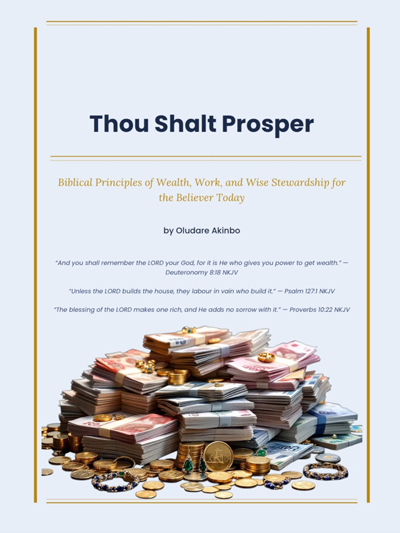
If this stirred something in you about what biblical prosperity really involves, including work, generosity, stewardship and the character that must come first, I have written a fuller book on it. Thou Shalt Prosper is free to read online or download.