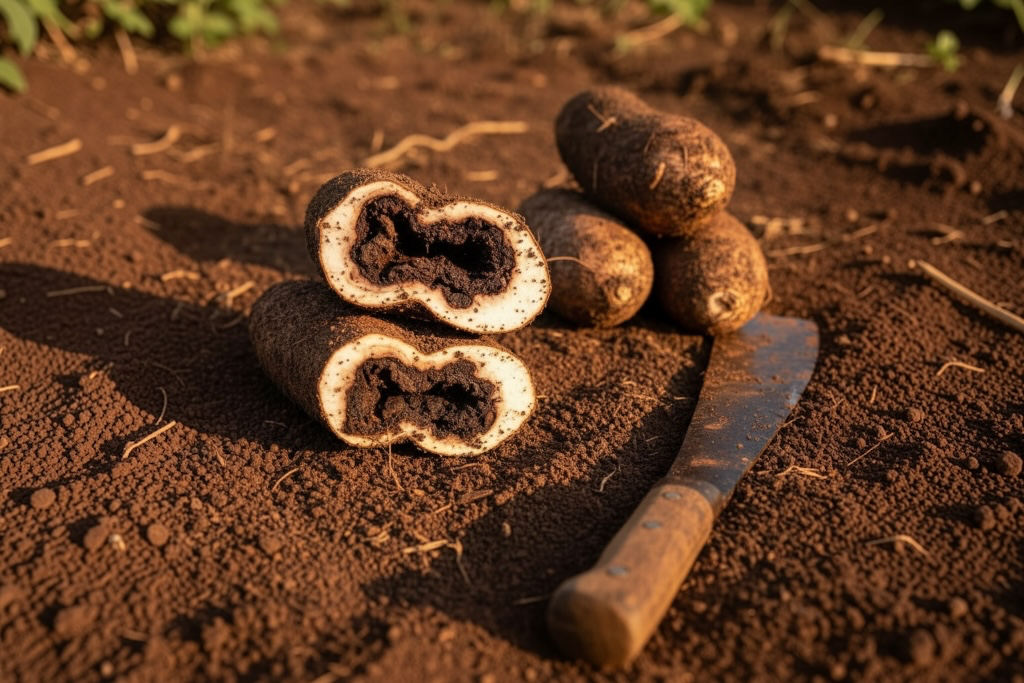
Every farmer knows the disappointment of digging up what looked, from the surface, like a perfectly healthy yam or cassava tuber — only to slice it open and find the inside soft, dark, and rotten. Nothing above ground warned you. The leaves looked fine. The stem stood tall right up until harvest day. But weeks, sometimes months earlier, a small insect had already bored its way in, or moisture had already begun quietly working through the flesh, unseen, unremarkable, easy to miss because nothing on the surface changed.
By the time you actually see the rot, you’re not looking at the beginning of the problem. You’re looking at its harvest.
Solomon gives us the harvest, too, in a verse most of us know by heart:
“Pride goes before destruction, and a haughty spirit before a fall.” — Proverbs 16:18, NKJV
We quote that verse often, usually after the fall has already happened — after the scandal breaks, after the ministry collapses, after the marriage ends in a way everyone saw coming except the person in the middle of it. But the fall isn’t where pride begins. It’s simply where it becomes visible. If we want to actually catch pride before it costs us anything, we have to stop staring at the harvest and go looking for the root.
The Root Scripture Actually Names
Moses, preparing Israel to enter a land of abundance they hadn’t yet earned by their own hands, gave a warning that reads less like a rule and more like a diagnosis:
“Beware that you do not forget the LORD your God… lest, when you have eaten and are full, and have built beautiful houses and dwell in them… then your heart is lifted up, and you forget the LORD your God… and you say in your heart, ‘My power and the might of my hand have gained me this wealth.'” — Deuteronomy 8:11-14, 17, NKJV
There it is, named plainly. Pride’s root isn’t ambition, or success, or even confidence — all of which can be perfectly healthy. Pride’s root is forgetting. Forgetting who actually provided the harvest. Forgetting whose strength was underneath your own effort the whole time. The moment a person quietly begins crediting themselves entirely for what was, in truth, a gift, the insect has already bored its way into the tuber. Everything above ground can still look fine for a good while yet.
Two Kings Who Forgot
Scripture gives us two vivid case studies of the same disease.
King Uzziah began his reign remarkably well:
“He set himself to seek God in the days of Zechariah… and as long as he sought the LORD, God made him prosper… But when he was strong, his heart was lifted up, to his destruction, for he transgressed against the LORD his God.” — 2 Chronicles 26:5, 16, NKJV
Notice the hinge: “when he was strong.” Not when he was weak or struggling. Strength itself was the very moment the forgetting crept in. He walked into the temple to burn incense himself, a task reserved only for consecrated priests, and was struck with leprosy for the presumption on the spot (2 Chronicles 26:16-21). The fall was sudden. The forgetting had been accumulating for years.
Nebuchadnezzar’s story is even more explicit, because Scripture actually records the exact sentence that tipped him over:
“The king spoke, saying, ‘Is not this great Babylon, that I have built for a royal dwelling by my might power and for the honor of my majesty?'” — Daniel 4:30, NKJV
That I have built. My might. My honor. Every pronoun in that sentence is doing the same quiet work Moses warned Israel about centuries earlier. And the humbling that followed was severe. But here’s what makes Nebuchadnezzar’s account worth sitting with rather than merely fearing: Scripture also records his restoration, once the forgetting was finally corrected.
“And at the end of the time I, Nebuchadnezzar, lifted my eyes to heaven, and my understanding returned to me; and I blessed the Most High and praised and honored Him who lives forever… Now I, Nebuchadnezzar, praise and extol and honor the King of heaven, all of whose works are truth, and His ways justice. And those who walk in pride He is able to put down.” — Daniel 4:34, 37, NKJV
Remembering was the cure for the same forgetting that caused the collapse. That order matters. It’s worth naming both directions honestly.
A River That Forgets Its Source
There’s a proverb common across several African cultures worth carrying with you: a river that forgets its source will dry up. A river doesn’t generate its own water. It simply carries what a spring, or the rains, or a mountain glacier upstream continually supplies. A river that somehow began believing its impressive width and force were entirely self-produced would be making exactly the mistake Uzziah and Nebuchadnezzar made — mistaking the channel for the source.
A Story Worth Sitting With
I once knew a businessman, self-made by most accounts, who had built something genuinely impressive from very little. In his early years, he prayed before every major decision, credited God openly in every testimony, and gave generously without needing to be asked twice. A decade of real success later, something had quietly shifted. He still attended church, still said the right words when asked. But the language around his own story had changed — “I built this,” “I saw the opportunity nobody else did,” “I made the calls that mattered.” Nobody around him could point to a single dramatic moment where the shift happened. It simply accumulated, success by success, the way moisture works its way into a tuber nobody’s watching closely. When a downturn eventually tested that business, the humility that once anchored him wasn’t there to meet it, and the fall, when it came, surprised everyone who’d only ever seen the healthy leaves above ground.
Five Questions Worth Sitting With
- In what area of my life has recent success quietly become “my power and the might of my hand” rather than a gift I’m grateful for?
- When did I last consciously thank God for something I’ve grown used to crediting to my own effort?
- Is there a “when he was strong” moment happening in my life right now — a season of strength where forgetting could easily creep in unnoticed?
- Do I speak about my achievements in a way that would sound accurate to someone who watched every hour I actually put in, prayer included?
- If I’m honest, is there a root already growing beneath the surface that I haven’t wanted to dig up and look at yet?
Final Word
The fall isn’t the disease. It’s the diagnosis, arriving late, usually once very little can still be done about it. The real work happens earlier, underground, in the quiet decision to keep remembering whose strength has carried you all along. Nebuchadnezzar’s story proves the root can be dug out even after the rot has spread far — humility restored what forgetting nearly destroyed. Better still, of course, to catch it while the leaves above ground still look perfectly fine, remembering daily that every harvest we call our own was first a gift from the Kingdom of God we’re still, quietly, being prepared for.